
Raccoon Removal for Central Virginia Homes
You’re hearing heavy thumping in the attic, scratching near the roofline, and chittering sounds while you’re trying to sleep. By morning it’s gone. Then it’s back the next night, and the next.
You may be dealing with a raccoon in the attic. Raccoons are strong, smart, and persistent. They can tear through vents and weak roofline areas to get into a warm place for shelter.
Lewis Pest Control & Wildlife Removal starts every raccoon removal job with an inspection. We look for entry points, tracks and nesting material.
If you’ve been searching for raccoon removal near me or raccoon in attic removal in the Greater Richmond area, our local wildlife removal team is ready to help. We follow Virginia wildlife guidelines, use an animal-first approach, and focus on getting the raccoon out while helping prevent the next one from getting back in.
Photo-Verified Inspections.
Humane Raccoon Removal. Environmentally Responsible.
Local Pros. No Door-Knocking.
Humane raccoon removal that accounts for whether there are babies
When a raccoon gets into your attic, there has to be a plan. Raccoon removal starts with figuring out why the animal chose your property, how it got in, and whether there may be young inside.
At Lewis Pest Control & Wildlife Removal, our humane raccoon removal process starts with a photo-verified inspection. We look for:
- Torn vents
- Loose soffits
- Damaged fascia
- Chimney gaps
- Roofline access points
- Tracks
- Droppings
- Nesting material
We also follow Virginia wildlife guidelines. That matters because raccoon removal in Virginia is not as simple as trapping an animal and dropping it somewhere else. In fact, that is illegal in Virginia.
Once we understand what is happening, we build a plan.
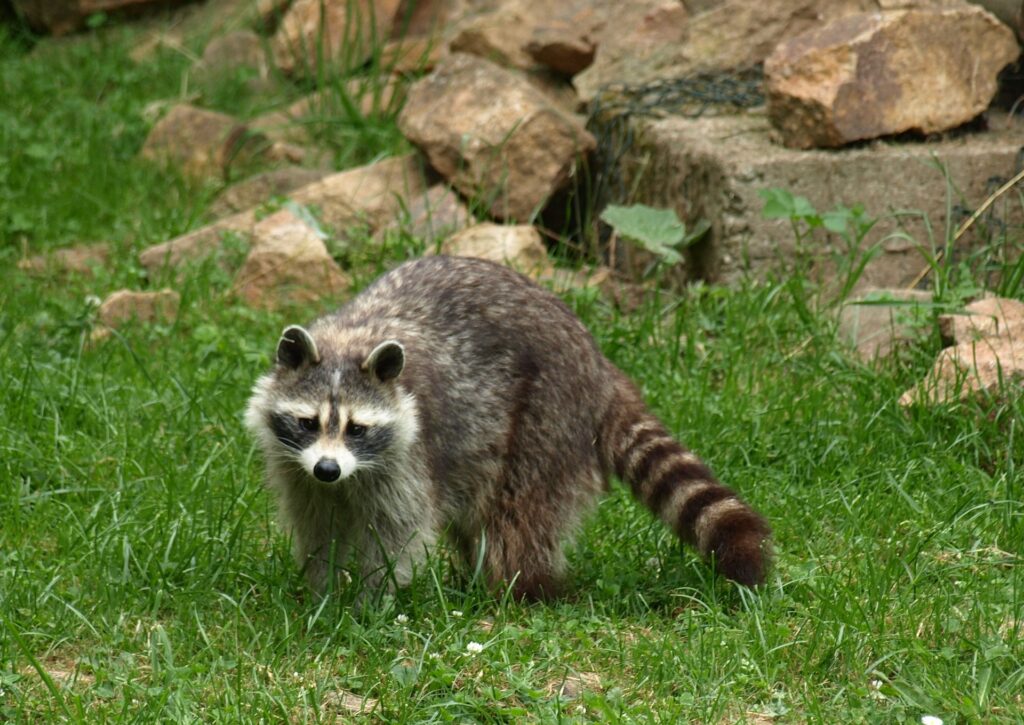
Mother raccoons search for safe and dry spaces — like your home
Most attic raccoons in Central Virginia are mothers. Raccoons in Virginia breed from January through March and give birth in April and May, with occasional late litters into summer.
If you are hearing scratching above your head during the spring, there’s a good chance you are dealing with a mother raccoon with 3–5 kits.
This changes how the job has to be done. A trap-and-release approach that catches the mother but leaves the kits behind is not the right approach. Orphaned kits will starve and die in your insulation. It’s simply not the right way to handle the issue.
We trap and remove the adults humanely, in accordance with Virginia wildlife regulations. Then we seal entry points with materials chosen to last — hardware cloth, sheet metal, and caulk colors matched to the trim so the repair doesn’t look like a repair.
If you’re hearing thumping overhead, don’t wait for the raccoon to leave on its own. Raccoons are smart enough to return once they know they have access to a safe and dry space.
One-Time Raccoon Removal
Worried there’s a raccoon in your attic? Call Lewis Pest Control & Wildlife Removal before you try to handle it on your own.
Raccoons, once they find shelter, keep coming back until the entry point is handled correctly. That’s why our raccoon removal service focuses on every way the raccoon can enter.
We provide humane raccoon removal for common situations like:
- Raccoon in attic removal
- Raccoons in chimneys
- Raccoons under decks or sheds
- Raccoons in garages or crawlspaces
- Raccoons around trash areas, chicken coops, or outdoor pet food
This does not have to mean signing a long-term pest contract. If you have one raccoon issue and need one-time raccoon removal, we can help.
If you’ve been searching for raccoon removal near me because you’re finding droppings around your property, call Lewis Pest Control & Wildlife Removal at 804-735-0100 to schedule service.
Attic restoration and biohazard cleanup after raccoons
Removing the animal is half the job. The other half is dealing with what it left behind — and this is the part most homeowners don’t understand about raccoons.
Raccoons designate a corner of your attic as a toilet. Over weeks or months, that area soaks through the ceiling and into the floorboards. Raccoon feces carry Baylisascaris procyonis — raccoon roundworm — which the CDC reports infects up to 82% of adult raccoons and 90% of juveniles in the wild.
Roundworm eggs are microscopic and can survive in the home environment for years. Children and pets are at the highest risk. This is one of those situations where every step of the raccoon removal process must be done right.
If you’ve had raccoons in your attic and you’re trying to figure out whether the cleanup is something you can handle yourself — call us first. We’d rather come look at it for free than have someone with no protective gear stir up roundworm spores trying to bag insulation.
Call us today at 804-735-0100.
Raccoons in Central Virginia Homes and Yards
Raccoons are one of the most common nuisance wildlife problems for homeowners. In Central Virginia, they are drawn to:
- Unsecured trash cans
- Pet food
- Bird feeders
- Gardens
- Fruit trees
- Chicken coops
- Chimneys
- Crawlspaces
- Decks
- Sheds
- Weak spots along the roofline
What to Look for Around Your Home
Most homeowners hear the problem before they see it. Raccoons are heavier than mice or squirrels, so the noises often sound like thumping.
Common raccoon warning signs include:
- Heavy thumping or scratching in the attic, usually at night
- Roofline damage
- Droppings or a strong odor in the attic
- Trash cans tipped over or food scattered outside
- Tracks, smudges, or claw marks near entry points
How to tell if it’s actually a raccoon in your attic
Most homeowners who call us are reasonably sure something’s up there. They’re less sure what — and that’s normal. Three animals account for almost every attic intrusion in the Greater Richmond area, and they sound, behave, and leave evidence in different ways. Here’s how to narrow it down before you call.
Raccoon. Heavy, deliberate sounds at night that sound bigger than the animal actually is. Vocalizations are the dead giveaway, and most of the signs happen after dark, especially late at night.
Squirrel. Light scurrying during daylight is the main sign. If the noise stops at night and resumes in the morning, our first thought is squirrels. Entry holes are smaller than a raccoon’s, and droppings are pellet-sized, around half an inch, often scattered through the insulation.
Opossum. Slower shuffling at night with long pauses points to an opossum. They don’t really vocalize. Droppings look similar to raccoon, but the edges curl as they dry — a useful tell. Entry tends to be through existing gaps rather than fresh holes.
Use this as a quick checklist:
- Daytime activity almost always means squirrels.
- Night vocalizations almost always mean raccoons.
- Fast scurrying in walls usually means mice or rats.
- Chirping or fluttering near the eaves points to birds or bats.
- If you see a larger animal, it is usually a raccoon.
When we come out for an inspection, the first thing we do is figure out what’s actually up there. Sometimes it’s the raccoon you suspected. Sometimes it’s something different that needs a different approach.
Why a Raccoon Problem Should Be Taken Seriously
Once raccoons find a safe den site, they can tear open weak points and contaminate insulation.
Damage to your home. Raccoons are strong enough to pull at vents — we’ve seen them rip vents completely off walls. In an attic, they compress insulation and leave urine and droppings. One of the worst things they do is chew through HVAC ductwork because it’s soft and explorable, and gnaw on electrical wiring. Chewed wires in attic insulation are exactly how house fires start.
Health and cleanup concerns. Raccoons often use repeat bathroom areas called latrines, and those areas may require careful cleanup. In attic or crawlspace situations, droppings, urine, and nesting material can contaminate insulation and create odor issues long after the animal is gone.
Rabies. Raccoons are a primary spreader of rabies to other wildlife, to unvaccinated pets, and to humans. This is one reason state law requires licensed handlers for trapping and removal.
Legal and animal-first removal. In Virginia, raccoon removal must be handled the right way. Lewis Pest Control & Wildlife Removal follows Virginia wildlife guidelines and uses an animal-first approach that protects your home while avoiding shortcuts that create legal, safety, or animal-welfare problems.
Risk to pets. Raccoons can be aggressive toward dogs and cats. Beyond a bite-fight scenario, raccoon roundworm transmits to dogs through contact with contaminated soil or attic material. If you have a dog that follows you into the house, that’s a real exposure pathway.
Insurance issues. Standard homeowners insurance typically covers raccoon damage to the structure of the home under accidental-damage provisions. It typically does not cover removal of the raccoons themselves, cleanup of biohazard contamination, or damage classified as long-term or preventable. The line between “covered” and “not covered” often depends on documentation — one of the reasons we document everything we find when we inspect.
If you’ve been searching for raccoon removal near me because you’re worried about damage that’s already happening, call us.
You’re Not a Wildlife Expert. You Shouldn’t Have to Be.
You shouldn’t have to figure out whether that thumping overhead is a raccoon, squirrel, or something else. That’s the job of a local raccoon removal company that actually knows what it’s doing. Here are the things we hear most often from Central Virginia homeowners before they call us.
“I’ll just block the hole tonight.” Please don’t, until you know what’s inside. If you seal an opening while a raccoon is still in the structure, you can trap the animal inside. If it’s a mother with young, you create an even bigger problem. A proper raccoon in attic removal starts with an inspection.
“We haven’t heard anything for a few nights, so I think it left.” Maybe. But raccoons come and go, especially when they’re using an attic as a den site. A few quiet nights do not mean another raccoon won’t use the same opening next week.
“My neighbor said to trap it and move it somewhere else.” That’s not how humane raccoon removal works in Virginia. Trapping a wild animal just to drop it somewhere else is not the right answer, and it can create legal, safety, and animal-welfare problems.
“I found droppings, but I’ll clean it up myself.” Be careful. Raccoon droppings can create health concerns, especially when raccoons use the same area repeatedly. We’ll help you understand what you’re seeing and whether the area should be handled with extra care.
“I only need this one raccoon gone. I don’t want a long contract.” That’s completely fine. Many raccoon calls are one-time wildlife issues. If you need one-time raccoon removal, we can remove the animal according to Virginia guidelines and recommend exclusion work — without pressuring you into a long-term pest contract.
DIY raccoon repellents don’t work
“I’ll just put mothballs up there.” Mothballs are one of the most common DIY raccoon repellents and also one of the most useless. In the volume of an attic, the smell dissipates, raccoons move a few feet away, and the only thing harmed is your indoor air quality. Mothballs also aren’t legal to use as a wildlife repellent under EPA labeling.
“I’ve got an ammonia-soaked rag up there to drive them out.” Same idea, same result. Ammonia evaporates quickly and attics are ventilated. A mother raccoon protecting kits will not leave the safest place she’s found because of a mild odor in the corner. She’ll move four feet away and stay.
“I left a radio on in the attic to scare them out.” Sometimes works for a day or two on a raccoon that hasn’t fully committed to the space. It doesn’t work on a mother with kits, because she has more to lose by leaving than by tolerating the noise. Raccoons in suburban Chesterfield are habituated to human sounds, and a radio is just another one.
When to be skeptical — and who actually handles raccoons
“It’s just one raccoon. How bad could it be?” If it’s spring or early summer in Virginia, it’s probably more than one. Raccoons give birth April through May, and the mother brings her kits into the safest space she can find. By the time you’re hearing noise, you’re dealing with a family — and the damage, contamination, and complexity are materially different from a single-animal job.
“A guy in a uniform showed up at my door and told me I have a serious raccoon problem.” Probably not a problem serious enough to be determined from your doorstep. Wildlife companies that send people door-to-door are usually selling a service you don’t need. If you got pitched a “we’ll come look right now for $X” by someone you didn’t call, get a second opinion. We do a real, free inspection.
“We called animal control. They said it’s not their job.” That’s usually right. County animal control in most of the Greater Richmond area handles dogs, cats, and sometimes injured wildlife on public property — not nuisance raccoons in private attics. They’ll often refer you to a licensed Wildlife Control Operator, which is what we are. If you’ve been bouncing between numbers trying to find someone who actually handles this, we’re the call.
Our Raccoon Removal Service Areas in Central Virginia
If you’ve been searching for raccoon removal near me, raccoon in attic removal, or humane raccoon removal and want a local team, Lewis Pest Control & Wildlife Removal is based right here in Chesterfield County and helps homeowners across Central Virginia with raccoon problems every week.
We regularly handle raccoon removal for homeowners, property managers, HOAs, and commercial properties in:
- Chesterfield
- Midlothian
- Bon Air
- Brandermill
- Woodlake
- Salisbury
- Moseley
- Chester
- Powhatan
- Richmond
- Henrico
- Glen Allen
- Short Pump
- Tuckahoe
- Mechanicsville
- Ashland
- Hanover
- Rockville
- Goochland
- Petersburg
- Colonial Heights
- Hopewell
Don’t see your neighborhood listed? If you’re anywhere in the Greater Richmond or Central Virginia area, give us a call. Whether you have a raccoon in the attic or repeated visits around trash cans or outbuildings, our local team can inspect the problem and explain the next step.
Raccoon Removal FAQs
What should I do if I think I have a raccoon in the attic?
Don’t seal the hole and don’t try to scare the raccoon out yourself. A raccoon in attic spaces may be using the area as a den, and during certain times of year there may be young inside. The safest next step is to call for raccoon in attic removal so a professional can inspect the entry point and build a removal and exclusion plan that doesn’t trap animals inside your home.
How do I know if the noises in my attic are from a raccoon and not squirrels or mice?
Raccoons usually sound heavier than squirrels, mice, or rats. Homeowners often describe the noise as thumping, slow walking, dragging, scratching, or rolling overhead, especially at night. Squirrels are usually faster and active during the day, while mice and rats make lighter scratching or scurrying sounds. The only way to know for sure is an inspection.
Why do raccoons keep coming back to my property?
Raccoons usually return because your property is giving them food, water, shelter, or an easy den site. Until both the attractant and the entry point are addressed, another raccoon can use the same opening.
How long does raccoon removal take?
Usually one to two weeks, and we want to be honest about that upfront because a lot of homeowners expect a one-visit job. Day one is the inspection and setup. Days two through seven or so are the active trapping phase, where we check traps daily, remove captured animals, and watch the activity pattern. If kits are involved, we may remove them by hand once we’ve located the nest and captured the mother. Once we’re confident the attic is empty, we move to exclusion. Some jobs go faster; spring jobs with kits typically take longer.
My dog tangled with a raccoon in the yard. What do I do?
First, get your dog to a veterinarian today, even if the dog seems fine — any bite, scratch, or saliva exposure from a rabies-vector species has to be evaluated. If your dog is current on rabies vaccinations, your vet will likely recommend a booster and an observation period; if not, the response is more involved. Second, if the raccoon is still on your property and acting unusually, don’t try to handle it — call Animal Control. Third, call us: even if this raccoon was a one-off, the fact that one came into close contact with your pet suggests the property has attractants worth identifying.
Ready to get the raccoons out and keep them out?
One-Time Raccoon Removal
Free Raccoon Inspection
Lewis Pest Control & Wildlife Removal handles raccoon removal the right way. If you’ve been searching for raccoon removal near me or humane raccoon removal, or you’re simply hearing something heavy moving overhead, our team is ready to help. Call us today at 804-735-0100 to schedule your raccoon inspection.